AP Business with Personal Finance Syllabus
AP Business with Personal Finance is an introductory, college-level business and personal finance course. Students explore the business disciplines of entrepreneurship, marketing, finance, accounting, and management through real-world business application, case studies, and project-based learning. In addition, students learn and apply all the National Standards for Personal Financial Education created by the Council for Economic Education and the Jump$tart Coalition for Personal Financial Literacy.
This course is designed to be the equivalent of a one-semester college introduction to business course and a one-semester college personal finance course.
Signature Projects
- Business Canvas Project (Units 1–4) — Students build a complete Business Model Canvas for their own business idea, including market research, financial projections, and a SWOT/Porter's Five Forces analysis.
- Financial Advisor Project (Unit 5) — Students prepare and communicate financial advice for a fictional household covering budgeting, education funding, home-buying, and retirement.
Projects are completed in groups of 1–3 students. Create or join your group, submit your Business Canvas link, and view assigned projects, deadlines, and your individual scores on the Project Groups page →
| Course: | AP® Business with Personal Finance |
| Academic Year: | 2026–2027 |
| Instructor: | Feng Gao |
| Email: | york@ghedu.com |
| Office: | 文体106 |
| First Day: | August 31, 2026 |
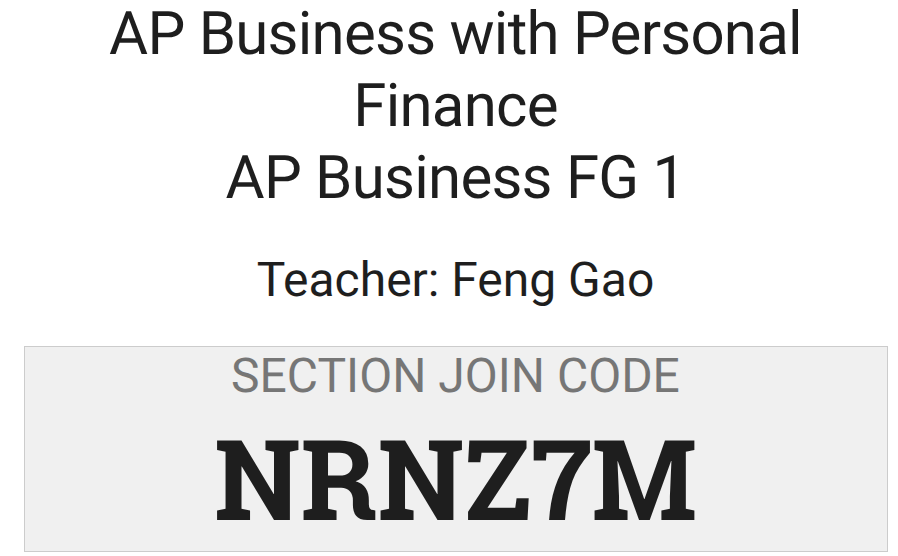
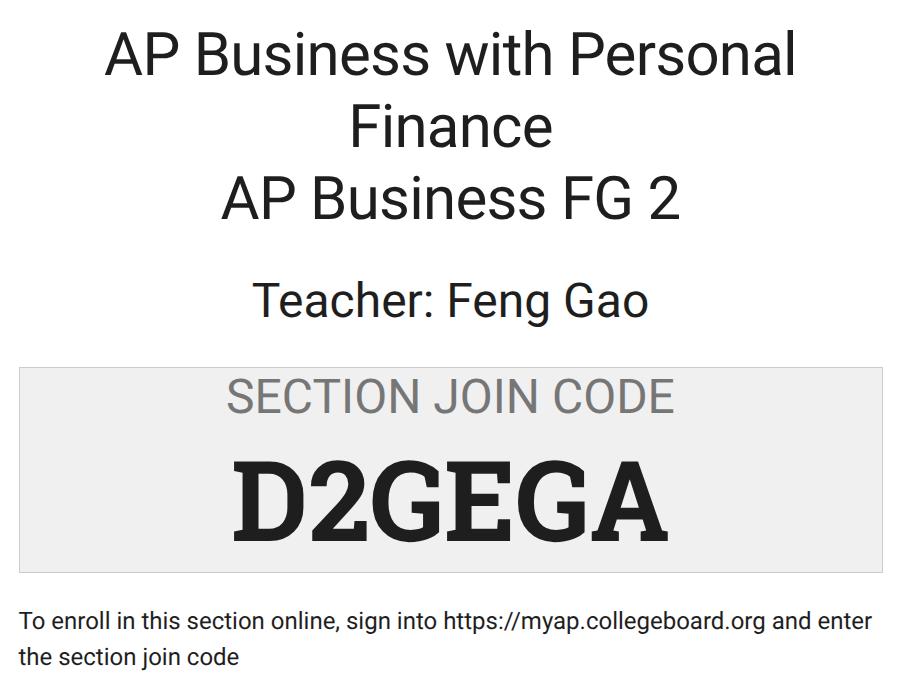
AP Classroom Join Codes
Sign in to myap.collegeboard.org and enter your section's join code to enroll online. Codes can be copied with one click.
Upon completion of this course, students will be able to:
- Understand business fundamentals — Explain how businesses create value, operate, compete, and make ethical decisions.
- Apply marketing concepts — Analyze how businesses use market research, consumer behavior, and marketing strategies.
- Master personal finance — Apply concepts of saving, borrowing, credit, debt, and investing.
- Analyze business finance — Interpret financial statements and understand business accounting.
- Evaluate management strategies — Use strategic frameworks like SWOT and Porter's Five Forces.
- Develop professional skills — Demonstrate communication, collaboration, and decision-making skills.
Textbook
College-level Introduction to Business textbook.
Course Materials (Provided)
- Course and Exam Description (CED)
- Business Canvas Project Guide
- Financial Advisor Project Guide
- Business Case Handouts (by unit)
- Slides for each topic
- Vocabulary Review Materials
Supplementary Resources
- AQA Business past papers (additional practice)
- Business documentaries and case study videos
- Online financial calculators and tools
Business Cases by Unit
- Unit 1: Bombas, VANCL/凡客, Labubu, Copa Di Vino, Pop Mart, Patagonia, Ctrip, Zara
- Unit 2: HEYTEA, Luckin Coffee, 茶颜悦色, New Coke, Dyson, 元气森林, Costco, Stanley, 花西子
- Unit 3: DK Coffee Lab (Parts 1–3), Hershey, AANE
- Unit 4: Canva, BREAUX Capital, ExpressionMed, Square Meal Feeds
Case Study Videos
Each unit’s cases are paired with the video clips used in the course slides. Suggested use: play a 5–10 minute clip, then identify the business concept it illustrates. Videos load only when scrolled into view.
Unit 1 — Business Foundations
1.1 Bombas — “Better Socks, Bigger Mission”
“Buy one, donate one” athletic socks. Gap, social enterprise, and risk–return (deal with Daymond John).
1.1 VANCL 凡客 — “人民快时尚”
Affordable apparel e-commerce that grew huge, then collapsed — a cautionary case.
1.1 ofo 小黄车 — bike-share collapse
Dockless bikes everywhere, but upkeep cost more than revenue; burned through billions and collapsed in 2018–19.
1.2 Cola vs Chinese Soda — cost advantage
Why can Coca-Cola profit at 3 yuan a bottle while domestic sodas lose money at 7?
1.2 得物 Dewu — differentiation through trust
The same sneakers sell elsewhere for less, yet Dewu charges more — authentication as the edge.
1.2 海底捞 Haidilao — service advantage
The same hot pot, but legendary service that commands premium pricing.
1.2 元气森林 Genki Forest — marketing positioning
“0 sugar” positioning, KOL blitz, and 日系 packaging built a $15B brand.
1.2 钟薛高 Zhong Xue Gao — hype without substance
Premium ice cream (20–60 yuan) via branding and social-media hype; no real differentiator, bankrupt 2024.
1.3 新东方 / 东方甄选 — PESTEL pivot
Double-reduction policy forced a pivot to livestream commerce — a legal/environmental factor reshaping a business.
1.3 Pop Mart / Labubu — social trend
A toy whose viral social trend (collecting, sharing, status) created a Southeast Asian resale market.
1.3 Shein — global fast-fashion giant
Ultra-cheap fashion across 150+ countries — one of the world’s most downloaded and controversial shopping apps.
1.4 Pop Mart — how blind boxes began
From a small blind-box shop to a multi-billion-dollar company — how a business idea originates.
1.4 Copa Di Vino — rejected on Shark Tank
Single-serve premium wine; rejected by every shark twice, yet built a $60M+ business.
1.5 Patagonia — values-driven company
A company that actually lives its environmental values. Mission-Driven Company (related ▶)
1.5 Seesaw Coffee — abandoning vision
What remains of a specialty-coffee brand after it chases a price war?
1.6 携程 Ctrip — business ethics
When a business has the data to charge loyal customers more — should it? (Big-data price discrimination.)
1.8 Supply Chain — a century of evolution
小Lin说 case study on how modern supply chains developed (3.6M views).
1.8 Zara — fast-fashion supply chain
How Zara’s vertically integrated supply chain powers its speed-to-market.
Unit 2 — Marketing
2.4 Dyson — from vacuum revolution to global brand
Product innovation story illustrating the product life cycle and product-led growth.
2.5 Penetration Pricing Strategy
An explainer on how and why firms set low initial prices to gain market share.
2.5 Costco — the $40M loss-leader chicken
Costco loses $40 million a year on its rotisserie chicken — completely intentionally.
Each semester is graded independently using the same standard. The midterm assessment accounts for 40% of the semester grade and the final assessment for 60%. Each is composed as follows:
Midterm Assessment — 40% of Semester Grade
| Category | Weight |
|---|---|
| Attendance | 15% |
| Class Participation | 15% |
| Homework | 20% |
| Midterm Exam | 50% |
Final Assessment — 60% of Semester Grade
| Category | Weight |
|---|---|
| Attendance | 15% |
| Class Participation | 15% |
| Homework | 20% |
| Final Exam | 50% |
Late Work Policy
- 10% deduction per day late; maximum 50% after 3 days late.
- Exceptions made for excused absences and emergencies.
Course Schedule
| Week | Dates | Topic / Unit |
|---|---|---|
| 1 | Aug 31 – Sep 4 | 1.1 What Is a Business? (Unit 1) |
| 2 | Sep 7–11 | 1.2 Markets and Competitive Advantage |
| 3 | Sep 14–18 | 1.3 PESTEL Factors |
| 4 | Sep 21–24 | 1.4 How Business Ideas Originate |
| 🌙 Mid-Autumn Festival — Sep 25–27 (No class) | ||
| 5 | Sep 28 – Oct 2 | 1.5 Vision; 1.6 Business Ethics |
| 6 | Oct 8–9 | Monthly Exam |
| 🇨🇳 National Day Holiday — Oct 1–7 (No class) | ||
| 6 | Oct 12–16 | 1.7 Organization; 1.8 Supply Chains — Unit 1 Complete |
| 7 | Oct 19–23 | 2.1 Marketing to Customers (Unit 2) |
| 8 | Oct 26–30 | 2.2 Consumer Behavior |
| 9 | Nov 2–6 | 2.3 Market Research — Midterm Exam |
| 📝 Midterm Exam Week — Nov 6–11 | ||
| 🍂 Autumn Outing — Nov 12 (No class) | ||
| 10–11 | Nov 16–27 | 2.4–2.7 Product, Price, Place, Promotion — Unit 2 Complete |
| 12–13 | Nov 30 – Dec 11 | 3.1 Saving; 3.2 Borrowing, Credit, Debt (Unit 3 Part 1) |
| 14–16 | Dec 14–31 | 3.3–3.8 Accounting, Financial Statements — Unit 3 Complete |
| 📝 Monthly Exam — Dec 14–18 (Monthly Exam Week) | ||
| 🎆 New Year Holiday — Jan 1 (No class) | ||
| 17 | Jan 4–8 | 4.1 Management and Leadership (Unit 4 Part 1) |
| 18 | Jan 11–15 | Final Exam Week |
| Winter Break: January 16 – February 28, 2027 | ||
| 19–20 | Mar 1–12 | 4.2 KPIs; 4.3–4.4 Strategy, SWOT, Porter's — Unit 4 Complete, Final Business Canvas due Mar 12 |
| 21 | Mar 15–19 | Unit 5: Taxes, Budgeting, Risk, Investing — Unit 5 Complete (all instruction done Mar 19) |
| 22–24 | Mar 22 – Apr 9 | Financial Advisor Project & Comprehensive Review |
| 📝 Monthly Exam — Mar 29 – Apr 2 (Monthly Exam Week) | ||
| — | Apr 26–30 | Mock Exams |
| 🎉 Labor Day Holiday — May 1–3 (No class) | ||
| — | May 3–14 | AP Business Exam |
| 📝 Final Exam Week — Jun 7–11 | ||
Key Dates
| Oct 16 | Unit 1 completed |
| Nov 27 | Unit 2 completed |
| Dec 31 | Unit 3 completed |
| Mar 12 | Unit 4 completed; Final Business Canvas Project due |
| Mar 19 | All instruction complete |
| Apr 9 | Financial Advisor Project due |
| Apr 26–30 | Mock Exams |
| May 3–14 | AP Exam |
Exam Window: May 3–14, 2027
Fully digital exam via the Bluebook Testing App. Total duration: 2 hours 40 minutes.
| Section | Questions | Time | Weight |
|---|---|---|---|
| Section I: Multiple Choice | 60 questions | 70 min | 60% |
| Section II Part A: FRQ 1 (Business Canvas Validation) | 1 question | 25 min | 15% |
| Section II Part B: FRQs 2–4 | 3 questions | 65 min | 25% |
Skill Categories Assessed
- Concept Application — Explain and apply business and personal finance concepts.
- Entrepreneurship — Develop and assess business ideas, test hypotheses.
- Decision Making — Analyze scenarios, evaluate alternatives, recommend actions.
- Communication — Create written and visual communications for business purposes.
- Collaboration — Work with others to accomplish business goals.